
Laundry Renovation Mistakes to Avoid in New Zealand Homes (2026 Guide)
Laundry Renovation Mistakes to Avoid in New Zealand Homes (2026 Guide)
A well-designed laundry can make everyday life easier — but when done poorly, it becomes one of the most frustrating rooms in the house. At Key Interiors, we renovate laundries across Auckland every week and know exactly what works — and what doesn’t. Whether you're working with a small space, updating cabinetry, or starting from scratch, this guide covers the most common laundry renovation mistakes Kiwi homeowners make (and how to avoid them).
Use our Free Laundry Renovation Estimator to check what layout options suit your space and budget.
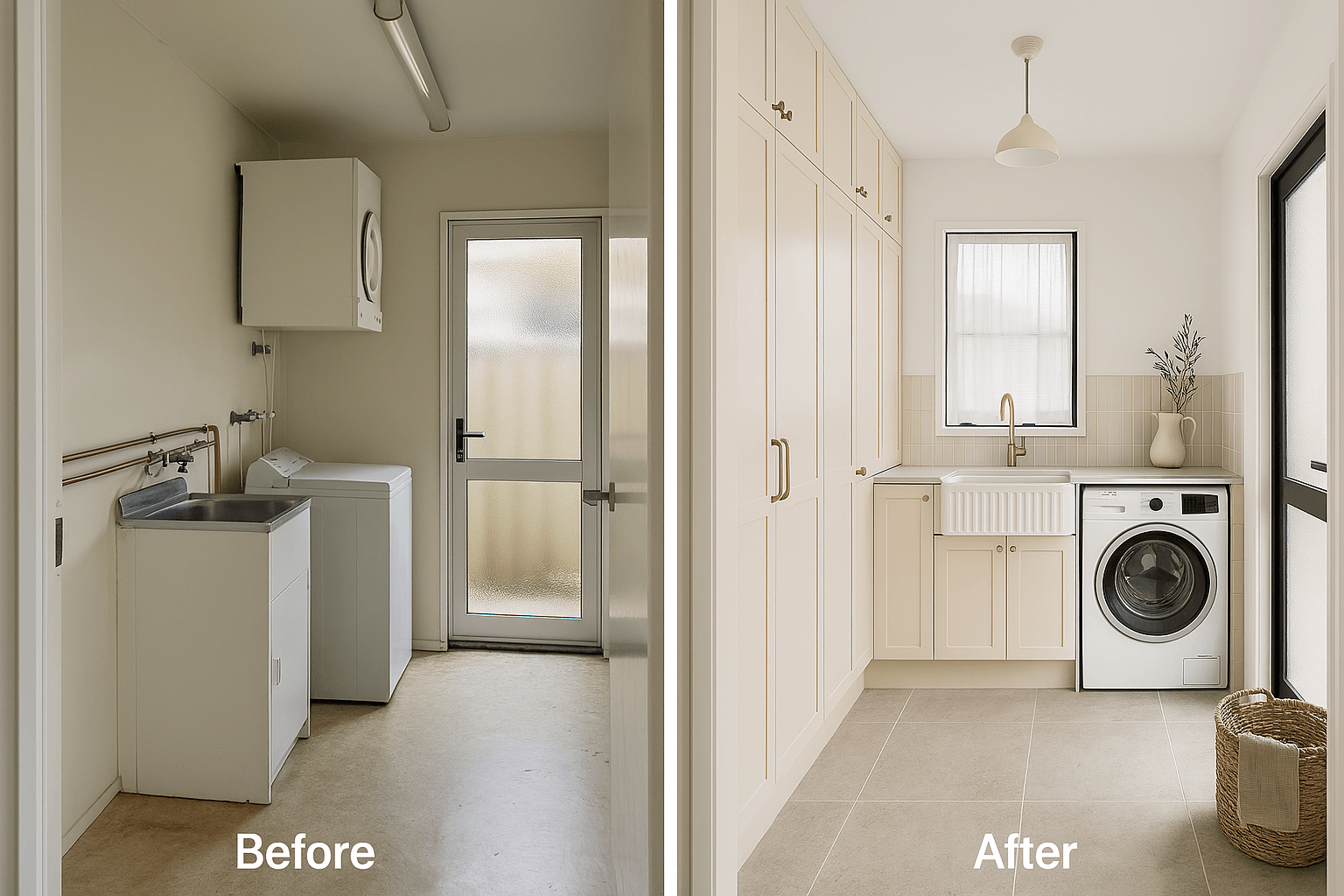
1. Poor Layout Planning
One of the biggest mistakes we see is a layout that doesn’t consider flow or function. Your laundry should be efficient and ergonomic.
Avoid this by:
Making sure your washer and dryer doors don’t open into each other
Placing benchtops at a comfortable height
Positioning your laundry basket near the machines
Including standing space for folding and movement
At Key Interiors, we offer full layout design during your free consultation — so nothing gets overlooked.
2. Wasting Vertical Space
Too many laundries have large blank walls with no storage. In New Zealand homes, especially villas and townhouses, space is tight — and every centimetre counts.
Avoid this by:
Installing overhead cabinets or open shelving
Using tall broom cupboards or slim pull-outs
Adding hanging rails for shirts and delicates
Including recessed storage where possible
Need help visualising the layout? Book your free consult or view real examples in our project gallery.
3. No Bench Space
A laundry without bench space makes folding clothes or sorting washing a chore. It also makes the room feel cramped and incomplete.
Avoid this by:
Running a benchtop over your front-loader washer/dryer
Including a pull-out folding bench
Choosing compact appliances to free up space for cabinetry
Use our Free Laundry Renovation Estimator to check what layout options suit your space and budget.
4. Forgetting Ventilation and Lighting
Ventilation is essential in laundries to prevent dampness, mould, and mildew — especially in Auckland’s humid climate.
Avoid this by:
Including a ducted extractor fan
Choosing energy-efficient LED lighting
Maximising natural light where possible
Adding a window or skylight if doing a major reno
We can assess airflow and moisture risks during your consult. It’s one of the most overlooked — and important — factors in any laundry.

5. Choosing Cheap Fixtures That Don’t Last
Your laundry takes a beating — water, heat, humidity, and daily use. Cheap melamine and poor-quality fittings will deteriorate fast.
Avoid this by:
Using moisture-resistant cabinetry like Melteca or Dezignatek
Choosing tapware that matches the kitchen/bathroom for consistency
Avoiding flat-pack unless it’s good quality and well-installed
Our team works with trusted NZ suppliers to ensure your laundry is durable and beautiful for years to come.
6. Skipping the Style
It’s easy to treat the laundry as a purely utilitarian space — but your laundry deserves just as much attention as the kitchen or bathroom. It’s also a great opportunity to carry your design style throughout the home.
Avoid this by:
Carrying through your colour scheme, handles, and tapware
Using statement tiles or splashbacks for visual interest
Selecting soft-close cabinetry, LED strip lighting, and wall hooks for polish
See our latest laundry renovations for inspiration on how to blend function and beauty on our projects page.
7. Designing it last, with whatever space is left over
This is the mistake underneath most of the others. On nearly every renovation the kitchen and bathroom get designed properly, and the laundry gets whatever cupboard is left at the end.
That is backwards, because the laundry is one of the few rooms with genuinely fixed requirements. It needs drainage, ventilation to outside, and a dedicated power circuit. Those are not things you can improvise into a leftover space cheaply.
Design it at the same time as the rooms around it and the services get planned once, instead of retrofitted twice.
8. Putting it in the wrong part of the house
Too far from where washing is generated. If the bedrooms are upstairs and the laundry is in the garage, every load is carried up and down twice. An upstairs laundry sounds indulgent until you count the trips.
Sharing a wall with a bedroom. A front loader on spin is loud and it transmits through the structure. If the laundry backs onto a bedroom, insulate that wall while it is open.
Upstairs over living space is convenient and raises the stakes on a leak considerably. Worth doing, but only with a floor waste, a drip tray and waterproof flooring.
Nowhere near the back door. In most family homes the laundry has absorbed the mudroom job. If it is at the far end of the house, the muddy boots end up in the hallway instead.
9. Not designing for the actual flow of washing
A laundry is a small production line, and the mistake is designing it as a room with a machine in it rather than as a sequence.
The sequence is: dirty arrives, gets sorted, gets washed, gets dried, gets folded, gets put away. Every one of those steps needs somewhere to happen.
Most laundries provide for the washing and nothing else, which is exactly why the folding ends up on a bed in another room and the clean basket sits there for three days. A bench to fold on and a way to sort are worth more than any finish in the room.
10. Under-sizing the services and not future-proofing
No provision for a dryer you will inevitably buy. Run the circuit and leave the space now. Retrofitting power into finished joinery is expensive and ugly.
Switchboard capacity. Older Auckland homes frequently cannot take a modern laundry plus a modern kitchen without an upgrade. Find that out at design stage, not when the electrician is on site.
Cabinets built to exactly 600mm deep. Machines need 650 to 700mm once hoses and the plug sit behind them. This is why so many machines stick out past the bench.
No isolating taps you can actually reach without dragging the machine out.
11. Ignoring the water-damage risk
Washing machine hose failures are among the most common domestic water damage claims there is, and the laundry is the one room where a slow leak can run behind a machine unnoticed for weeks.
A floor waste wherever the floor construction allows it.
Braided stainless hoses, replaced every few years rather than left for the life of the house.
A drip tray under the machine in any upstairs or cupboard laundry.
Waterproof flooring with sealed junctions, particularly over living space.
Turn the taps off when you go away.
None of these cost much during a renovation. All of them cost a great deal afterwards.
12. Getting the dryer decision wrong
Worth stating plainly because it causes more damage than anything else on this list: a vented dryer must duct to the outside. Venting it into a cupboard, into the roof space, or into a small closed room grows mould in the cabinetry and in the ceiling above it.
In a hidden or cupboard laundry, specify a heat pump dryer. No duct, far more efficient to run, and it removes moisture from the clothes rather than releasing it into the room. More on the options in small laundry room ideas that actually work.
13. Forgetting the laundry is also the drying room
Most New Zealand households dry washing indoors for a good part of the year, and a single load releases a couple of litres of water into the air of your house as it dries.
Do that on a clothes horse in a cold lounge through an Auckland winter and you are effectively running a humidifier in a damp house, which is how you get condensation on the windows and mould in the wardrobes. Designing a ventilated place for wet washing to dry, whether a heat pump dryer, a drying cabinet extracted outside, or an airer in a room with real extraction, is one of the most useful things a New Zealand laundry can do. Almost nobody plans for it.
14. Using kitchen specifications in a laundry
A laundry is harsher than a kitchen: standing water, detergent, bleach and constant humidity.
Moisture-resistant carcasses, without exception. Standard board swells permanently the first time it gets wet and cannot be repaired.
Thicker edge banding, because this is exactly where water sits and lifts it.
A hard-wearing benchtop. Laminate is genuinely sensible here. Avoid anything porous that needs sealing near a tub.
A deep tub, not a shallow designer one you cannot soak anything in.
15. In a villa or bungalow, underestimating the job
Character homes were not built with an internal laundry. It was a wash-house out the back or under the house, so bringing it inside is a services project rather than a cosmetic one.
New drainage and a new power circuit are usually the real cost, not the joinery.
The floor is likely out of level after a century of pile movement, which matters for both cabinetry and machine stability.
Nothing is square, so cabinetry has to be scribed rather than dropped in.
These rooms are cold and often uninsulated, which makes them the most mould-prone space in the house. Insulate while the linings are off.
More on what older Auckland homes involve in our villa renovation guide.
What it should actually cost
A proper Auckland laundry renovation generally runs $10,000 to $20,000 for a good mid-range fit-out, with premium projects up to around $40,000, and a basic refresh under $10,000.
Small does not mean cheap. The plumbing, electrical, ventilation and joinery costs barely change with floor area, which is why a 2m² laundry costs a surprising proportion of what a much larger room does. The breakdown is in our Auckland laundry renovation cost guide.
Want a Smarter Renovation?
Avoid costly mistakes and create a laundry that actually works for your lifestyle.
✅ Try our Free Laundry Cost Estimator
✅ Book a free consultation to speak with one of our interior experts
✅ Browse recent laundry renovations in Auckland
We’ll handle the entire process — from design to install — with clear communication, transparent pricing, and a beautiful end result.