
A bathroom renovation in Auckland costs between $35,000 and $90,000 in 2026. Most Auckland homeowners spend $45,000 to $60,000 on a full mid-range bathroom. A compact main bathroom or ensuite done properly starts around $35,000. Luxury bathrooms with bespoke joinery, stone and premium tapware run $60,000 to $90,000 and up.
A bathroom is the highest cost-per-square-metre room in the house. A 7 square metre bathroom at $42,000 works out at $6,000 per square metre, which is roughly double a whole-home average. That is not a markup. Everything in a bathroom is wet-area work: waterproofing, tiling, and services all packed into the smallest room you own, and every one of them has to be right.
Auckland also runs 10 to 20 percent above the rest of New Zealand. Skilled trades here charge $90 to $150 an hour against $70 to $120 in most other regions.
2026 PRICE GUIDE: AUCKLAND BATHROOM RENOVATIONS
Essential: $35,000 to $45,000. A compact main bathroom or ensuite, done properly. Full strip-out, new waterproofing, quality tiling, vanity, shower, toilet and tapware. Standard fittings, existing layout kept.
Mid-range (most popular): $45,000 to $60,000. The full job. Better tiling and stone, custom vanity, frameless glass shower, heated towel rail, ventilation and lighting done properly. Some layout change.
Luxury: $60,000 to $90,000 and up. Bespoke joinery, stone benchtops and slabs, premium European tapware, underfloor heating, feature lighting, and a layout designed rather than inherited.
All figures include GST. Prices assume Auckland labour rates and a standard-access site.
WORKED EXAMPLE: A REMUERA BATHROOM, 7 SQUARE METRES
This is a worked example built from our Auckland pricing. It is illustrative, not a specific client’s job, and every bathroom prices differently once we have seen it. It is here to show where the money actually goes.
Strip-out and disposal $2,400. Waterproofing $2,800. Tiling to floor and full-height walls, supply and lay, $9,600. Custom vanity with stone top $6,200. Frameless glass shower, mixer and rail $4,800. Wall-hung toilet and in-wall cistern $2,900. Tapware and fittings $2,600. Plumbing $4,200. Electrical, being lighting, extractor and heated towel rail, $3,100. Painting and making good $1,400. Supervision and project management $2,000. Total $42,000.
Tiling and waterproofing alone are 30 percent of that room. That is the part nobody sees and the part that fails in five years if it is done cheaply.
WHERE THE MONEY GOES IN A BATHROOM
Tiling and waterproofing 25 to 30 percent. Joinery and vanity 15 to 20 percent. Tapware, shower, toilet and fittings 15 to 20 percent. Plumbing and electrical 15 to 20 percent. Labour, supervision and project management 15 to 20 percent.
The two lines people try to cut are waterproofing and tiling. They are also the two that decide whether the room lasts twenty years or leaks in five. If a quote is well under $35,000 for a full Auckland bathroom, something in those two lines has been thinned out.
WHAT MOVES THE PRICE
Moving the plumbing. Relocating a toilet, shower or vanity means new drainage and adds $2,000 to $5,000 before you choose a single finish. Keeping the layout is the single biggest saving available.
Tiling choice and coverage. Full-height tiling costs more than half-height. Large-format and natural stone cost more to lay than standard ceramic, because they are slower and less forgiving.
Villa and character homes. Pre-1940s bathrooms often need subfloor work, rewiring and replumbing before the fun starts. Budget 25 to 40 percent more than an equivalent job in a 1990s home.
Second bathrooms. An ensuite done at the same time as the main bathroom costs less than the first, because the trades are already on site.
HOW LONG DOES A BATHROOM TAKE?
Typically three to five weeks on site for a full bathroom renovation, plus design and any consent beforehand. It is not three weeks of continuous work: waterproofing has to cure, tiling has to set, and trades come in sequence. Anyone promising two weeks is either not waterproofing properly or not telling you about the gaps.
What actually drives the number up or down
Two bathrooms of identical size can be $20,000 apart. It is almost never the tiles. These are the five things that genuinely move a quote.
1. Whether the layout changes
Keeping the toilet, shower and vanity broadly where they are is the single biggest saving available. Moving a waste typically adds $3,000 to $5,000 in plumbing, more if it means cutting a concrete floor, and relocating fixtures can push a job from a Schedule 1 exemption into needing building consent.
The toilet is the expensive one, because its soil pipe is larger and needs consistent fall. Basin and shower wastes are more forgiving. If your current layout nearly works, keep it and spend the difference on finishes you touch every day.
2. Waterproofing, and what is behind the walls
Every full renovation means new waterproofing to clause E3, and it is the last place to save money — a failed membrane is not a repair, it is the room out again.
The bigger budget risk is what turns up once the old room is out. In Auckland villas and bungalows it is normal to open a wall and find dated plumbing, borer, rot in the lean-to framing, a floor well out of level, or asbestos in a 1970s vinyl floor. Carry a 10 to 15% contingency on any pre-1940 home. A quote with no allowance for this is not cheaper, it is incomplete.
3. Tiling scope, not tile price
Floor-only tiling with painted walls above sits at the affordable end. Floor-to-ceiling tiling everywhere sits at the premium end. Tiling is labour, so the gap is thousands rather than hundreds, and it is driven by how much area you tile far more than by what the tiles cost per square metre.
Large-format tiles also lay faster than mosaics and small formats, so they often cost less to install while making a small room read calmer. Fewer grout lines is less cleaning, too.
4. Fixtures and fittings
A vanity can be $600 or $6,000. Tapware, shower systems and toilets span a similar spread. Mid-range from a reputable brand with available spare parts is the sweet spot for most homeowners; custom joinery and designer brassware move you into the premium tier.
This is the part of the budget you control most directly, and the part with the least consequence if you choose modestly.
5. Warmth and ventilation
Underfloor heating typically adds $1,500 to $3,500 depending on the area. A quality heated towel rail is a few hundred. A properly ducted extractor is not optional in an Auckland winter.
These are the best value-for-money items in the whole project, and the ones clients most often say they would never give up. If the floor is coming up anyway, underfloor heating will never be cheaper to install than right now.
Why a small bathroom is not proportionally cheaper
People expect a 4m² bathroom to cost roughly half a 7m² one. It does not.
The materials scale with area, but the trades largely do not. The plumber, the electrician, the waterproofer and the tiler all have to attend, set up and work through essentially the same sequence regardless of whether the room is small or large. Strip-out, rough-in, membrane, cure time, fit-off — that programme barely changes.
So a small bathroom saves you on tiles and maybe a smaller vanity, and very little else. It is the most common reason a quote comes in higher than someone expected for a compact ensuite.
How to budget with confidence
Settle the layout first. Every other decision is cheaper to change than this one.
Get the house investigated before pricing if it is pre-1940 — subfloor, piles, drains, asbestos. Known beats discovered.
Add 10 to 15% contingency on an older home, and treat it as part of the budget rather than a buffer you hope not to use.
Ask what is a provisional sum and what is fixed. A quote with a few named, realistic allowances is more honest than one with none.
Spend on what you cannot change later — waterproofing, falls, ventilation, heating in the floor. Save on what you can swap in an afternoon.
For where to save without wrecking the job, see renovating a bathroom without blowing the budget, and for layout choices in a compact room, small bathroom layouts that work. If your home is a villa or bungalow, our villa renovation guide covers what usually turns up behind the walls.
FREQUENTLY ASKED QUESTIONS
How much does a bathroom renovation cost in Auckland?
Between $35,000 and $90,000 in 2026. Most Auckland homeowners spend $45,000 to $60,000 on a full mid-range bathroom. Compact main bathrooms and ensuites start around $35,000.
Why do bathrooms cost so much per square metre?
A 7 square metre bathroom at $42,000 is $6,000 per square metre, roughly double a whole-home average. Everything in the room is wet-area work: waterproofing, tiling, plumbing and electrical, all packed into the smallest room in the house.
Can I renovate a bathroom for under $35,000 in Auckland?
Sometimes, if you keep the existing layout, keep the plumbing where it is, and choose standard fittings. But a quote well under $35,000 for a full Auckland bathroom usually means the waterproofing or the tiling has been thinned out, and those are the two lines you never cut.
Do I need consent for a bathroom renovation?
Like-for-like replacement generally does not need consent. Moving or adding plumbing, altering structure, or changing the building envelope does. Budget $2,000 or more and allow real time for Auckland Council.
How much does it cost to move the plumbing?
Relocating a toilet, shower or vanity adds $2,000 to $5,000 in drainage, plumbing and making good, before you pick a single finish. Keeping the layout is the biggest saving on the board.
Does an ensuite cost the same as a main bathroom?
Less, if it is done in the same job, because the trades are already on site. On its own it costs close to the same, because the fixed costs do not shrink with the room.
How much more does a villa bathroom cost?
Around 25 to 40 percent more. Pre-1940s homes often need subfloor repair, rewiring and replumbing before any of the visible work starts, and none of that shows up until the linings come off.
How long does a bathroom renovation take?
Three to five weeks on site, plus design and consent beforehand. Waterproofing needs to cure and tiling needs to set, so the timeline is not compressible past a point.
RENOVATING A BATHROOM IN AUCKLAND?
Key Interiors designs and builds bathrooms across Auckland’s central, city-fringe and eastern suburbs. One team from design through to handover, and a fixed price once the design is locked. Get a free tailored estimate using real Auckland pricing, or book a free consult and we will talk through what your bathroom actually needs.

🔹 2026 Price Guide: Auckland Bathroom Renovations
At Key Interiors, we specialise in bathroom renovations that are as functional as they are beautiful—no matter your budget. Here’s a breakdown of what you can expect to spend:
1. Basic Renovation: $35,000 – $45,000
A compact main bathroom or ensuite, done properly.
Inclusions:
Retains existing layout
Standard tiles and fittings
New vanity, toilet, and shower unit
Simple paint refresh and lighting
Basic waterproofing
2. Mid-Range Renovation: $45,000 – $60,000
Our most popular option.
Inclusions:
Layout tweaks if needed
Mid-range tile selections (e.g. porcelain or feature walls)
Upgraded vanity and tapware
Tiled shower or freestanding bath
Custom lighting plan
Premium waterproofing and ventilation upgrades
3. Luxury Renovation: $60,000 – $90,000+
For a bathroom that feels like a day spa.
Inclusions:
Full layout redesign
Underfloor heating
Natural stone or handmade tiles (e.g. zellige)
Fluted vanities, brushed brass tapware
Frameless glass, wall-hung toilets, skylights
Designer lighting, integrated niches, floating cabinetry
🧰 What Factors Affect the Price?
Room size & layout changes
Quality of tiles, fittings & finishes
Custom vs off-the-shelf cabinetry
Demolition complexity & plumbing changes
Waterproofing & ventilation upgrades
Project management & design services
✅ Why Work With Key Interiors?
We combine high-end design with practical, cost-effective solutions
You’ll receive a fixed-price quote, no hidden surprises
Our in-house team handles everything—design, trades, materials, and finish
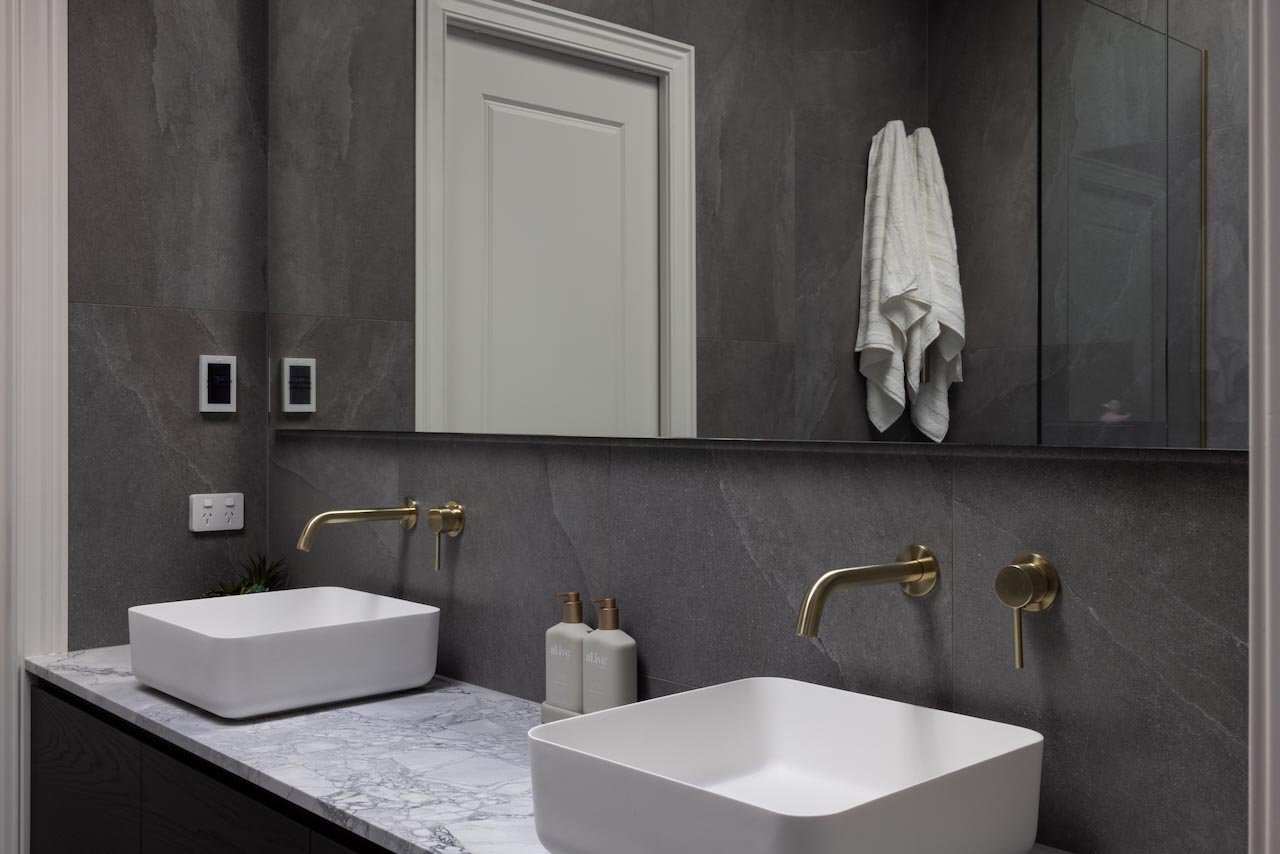
Here’s a Parnell villa bathroom we did end to end, from strip-out to styling.
If you’re looking at renovating, check out our free online cost estimator and get a free estimate in under 60 seconds!
📌 Frequently Asked Questions
What’s the average cost of a bathroom renovation in Auckland?
The average cost of a mid-range bathroom renovation in Auckland in 2026 is around $45,000 – $60,000. This usually includes modern tiles, upgraded fittings, waterproofing, lighting, and minor layout changes.
Can I renovate a bathroom for under $35,000?
Yes, if you're keeping the existing layout and selecting budget-friendly materials. This price range suits rental properties or small bathrooms with minimal changes.
What’s included in a high-end bathroom renovation?
Luxury renovations often include underfloor heating, natural stone or zellige tiles, designer fittings, custom cabinetry, layout redesign, and high-end lighting. These projects are fully customised.
How long does a bathroom renovation take?
Typically 3–6 weeks depending on the size and scope. Timelines may vary if there are custom orders or structural changes involved.
Can I get a fixed-price quote?
Absolutely. At Key Interiors, we offer transparent, fixed-price proposals—so you know exactly what to expect before we begin.
If you’re looking at renovating, check out our free online cost estimator and get a free estimate in under 60 seconds!